
MATERIALS & SCIENCE NOTE 01
What goes into a heat pack?
Iron powder, carbon and the role of packaging
THE SHORT VERSION
Air-activated heat packs release heat as iron oxidizes. Common ingredients include iron powder, water, salts, activated carbon and moisture-retaining materials. Performance depends on the complete product: its mixture, pouch, fill weight, outer packaging and conditions of use.
This guide summarizes manufacturers’ public information and adds questions for buyers. It is not a formulation or a test report for LinHang NuanXin products.
01 / Why does a heat pack warm up?
Opening the sealed outer wrapper allows oxygen to reach the contents through the inner pouch. Iron oxidation releases heat. Water and salts support the reaction, while the other materials and the pouch help manage the conditions in which it takes place. Kobayashi’s explanation of Kiribai warmers describes the ingredients and the role of the packaging. [1]
This guide concerns disposable heat packs and hand warmers. Rechargeable warmers, hot-water bottles and reusable crystallization warmers work differently.
“Air-activated” does not mean that every product reaches the same temperature or lasts the same length of time. Compare the instructions and specifications for the exact model, including the conditions used to measure its performance.
02 / Five common ingredient groups
The table brings together public explanations from Kobayashi and ST. Ingredient choices differ between products; this is not a universal recipe or a statement of our own formulation. The buyer questions are our interpretation of those sources. [1][2]
| Ingredient group | Role described in public sources | What buyers can ask |
|---|---|---|
| Iron powder | The main material that releases heat through oxidation. | Does the complete product meet its stated temperature and duration specifications? |
| Water | Provides moisture needed for the reaction. | How are performance and shelf life verified for the packaged product? |
| Salts | Help the oxidation reaction proceed. | Are the ingredient descriptions consistent across the label and specification sheet? |
| Activated carbon | Helps bring oxygen into contact with the reaction mixture. | Is the supplier explaining the full mixture and pouch, rather than one ingredient in isolation? |
| Moisture-retaining materials | Materials such as vermiculite, wood powder or water-retaining polymers help retain water; choices vary by product. | Which materials are declared for the specific model being sampled? |
An ingredient name alone cannot establish quality, safety or warming duration. Ask for evidence tied to the complete model and its intended use.
03 / Packaging is part of performance
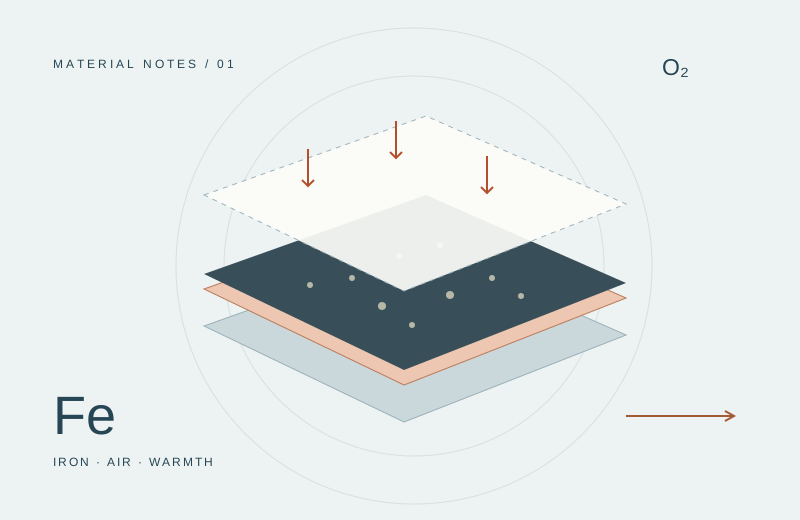
The inner pouch manages incoming air
Kobayashi explains that different products use small openings or specially breathable materials to regulate air entry. For procurement, evaluate the pouch together with the heat-generating mixture. There is insufficient basis for assuming that greater breathability always gives a better product. [1]
The outer wrapper keeps the reaction from starting early
The sealed outer wrapper blocks air before use. Its integrity therefore matters for storage. When specifying OEM packaging, ask about the packaging specification, seal checks and storage conditions as well as artwork and language. [1]
An adhesive layer does not define skin suitability
A patch intended for clothing has a different use instruction from a product intended for direct skin contact. For example, the public Kiribai adhesive Magma product page specifies application to clothing and warns against direct skin contact. Adhesive backing alone does not establish suitability for skin. [3]
04 / How to read published product information
Brand documentation is useful for understanding how performance is described. Start with an exact model, then record ingredients, temperatures, duration, dimensions and test methods. Avoid combining specifications from different products under one brand name.
| Public source | What it helps explain | What it cannot establish |
|---|---|---|
| Kobayashi · Kiribai | The warming principle and roles of ingredients and packaging. | The formulation used by every other manufacturer. |
| ST · Onpax | Different moisture-retaining materials and the relationship between use and performance. | Which product is better based only on ingredient names. |
| Kiribai adhesive Magma model page | The distinction between maximum temperature, average temperature, duration and test notes. | Specifications for our own products. |
Read a “12-hour” duration claim together with its temperature threshold and test conditions. Ask which environment and measurement method were used, and what qualifies as warming time. A stated duration does not mean the temperature stays constant throughout that period.
05 / Six questions before sourcing
This checklist is an interpretation of the sources above for sample discussions. Acceptance criteria should still be agreed for the selected model, destination market and order.
- Intended use: Is it a body patch, hand warmer or foot warmer? Where and how should it be placed?
- Materials and dimensions: Do the label, specification sheet and sample describe the same product?
- Temperature and duration: Are maximum temperature, average temperature, duration and measurement conditions all stated?
- Complete-product testing: Do the results apply to this sample’s pouch, fill weight and packaging?
- Storage and packaging: Are shelf life, storage conditions, seal checks and transport packaging specified?
- Instructions: Are warnings, restrictions and language versions appropriate for the intended users and readable on the sample packaging?
For LinHang NuanXin, materials, temperature curves and packaging specifications are subject to the agreed model documentation. See our body warmer information or OEM customization overview.
06 / Use and storage start with the model’s instructions
An explanation of ingredients does not replace the product instructions. Do not apply clothing-only patches directly to skin, use them while sleeping or combine them with other heating devices. Monitor how the product feels and stop using it if it becomes too hot or uncomfortable. Read the complete warnings for the model and its intended users. [3]
Keep the outer wrapper intact and follow the stated storage conditions and expiry date. Do not continue using a product with a damaged pouch, leaking powder or other abnormal condition. This article does not provide instructions for opening, mixing or making heat packs.
Sources and editorial notes
This article summarizes public information and interprets it for procurement. We did not conduct independent material testing, disclose or infer proprietary formulations, or rank brand performance. Sources reviewed: October 12, 2026.
- Kobayashi: How warmers work (Japanese)Manufacturer’s primary information on the warming principle, ingredients and packaging.
- ST: How warmers work and their temperature (Japanese)Manufacturer’s primary information on ingredient options and product performance.
- Kobayashi: Kiribai adhesive Magma product information (Japanese)Model-specific examples of performance labeling, clothing use and warnings.
Revision history: 2026-10-12 · First edition. Readers are welcome to contribute publicly citable sources or corrections.